Monday, 14 December 2009

First draft of magazine review


[ click on the image to enlarge ]
Thursday, 10 December 2009

'A long way from home' film review

Long way from home review [text only]

Plot
Ryan (James Kennedy) has just returned home from war to his wife Helen (Luisa Di Maria), but it’s not the heartfelt homecoming that was expected.

Review
‘Long way from home’ is a contemporary Short on the issues of war. Kennedy portrays a ‘lost soul’ back from war who suffers from post-traumatic stress disorder presented to us through a series of interviews with the characters. Some scenes offer the audience a peak ‘backstage’ of their lives, where you see how they cope with this situation.
The film does not go in depth about PTSD, but simply highlights the issues of soldiers affected by war and their families. The mixture of drama and documentary varies the dynamic of the film, which, as a genre reflects earlier work such as ‘City of God’ and ‘The Nines’.
From the director of ‘Following Seth’ as well as its lead actor Lewis Page, this short offers an alternative from the monotonous mainstream films.

Verdict
A definite must see if only to see these upcoming actors' stunning performance.

Wednesday, 18 November 2009

Audience feedback

Audience feedback


1. Male [ ] Female [ ]


2. Age group:
U16 [ ] 16-18 [ ] 19-25 [ ] 25+ [ ]


3. What genre of film do you enjoy?


4. Would you normally watch short films?
Yes [ ] No [ ] Sometimes [ ]


5. If so, how often do you watch them?
Rarely [ ] Often [ ] Very Often [ ]


6. Did you enjoy the film? Rate it between 1 – 5, 5 being the highest

1 2 3 4 5


7. What did you think of the combination of a documentary with drama?


8. How did you feel watching the film?


9. If you could change anything to improve it, what would you suggest?


10. Additional comments and reflection

This questionaire was filled out on paper and the data gathered will be explained in the evaluation. I also published my film on youtube to allow people to leave comments about the film and their thoughts on it.

Monday, 16 November 2009

Conventions of a magazine review

What it must include:

- The plot

- Verdict

- Pictures

- Intertextuality with referencing other actors and films

- Media/ film jargon e.g. 'cgi'

Evaluation

In what ways does your media product use, develop or challenge forms and conventions of real media products?


Short films tend to explore issues within society, for instance domestic violence. It seems this is because there are less layers of narrative, which allows the producer to present his message so that its ‘to the point’. For ‘A long way from home’, I chose the content to be of a contemporary issue. I looked at what was happening in Afghanistan at the moment, and wanted to look at the effect was has on soldiers. I thought it would be easier to put this across without much distractions from sub-plots or layers.
Due to the lower budget invested in making Shorts compared to feature length films, I found it much simpler to develop the forms and conventions of ‘real’ Shorts. The production, because of the low budget involved in the project, may then not be interpreted as being realistic, though it is in a semi-documentary form and so may under take the conventions of this genre. With this in mind, the settings used within my media product coincide with the tone of the film and its conventions. It was hard to organise my actors and location. I had to mainly use my school as a location for settings such as a kitchen, which may challenge the concept of realism. When Helen is being interviewed, she is meant to be in her kitchen/ dinning area with a cup of tea talking, however due to circumstances I had to use the café whilst everyone were in their lessons. I believe, however, that this scene still works. I also chose to show shots of mundane life, for instance when Helen steps out of the bathroom. The most realistic of interviews in the film, I feel is the one with Jack. This was filmed in a pub and all the non-diegetic noise is real from everyone else that was there.

Some of the main forms and conventions of film posters could include: A large title which attracts the eye, bold colours which stand out from the background, intriguing picture which would attract viewers to the film, persuasive language which might persuade the viewers to go and see the film, using the main character's name for promotion, and the certification to ensure that the right type of people are watching the film. A successful film poster will accomplish attracting the target audience and persuade them.


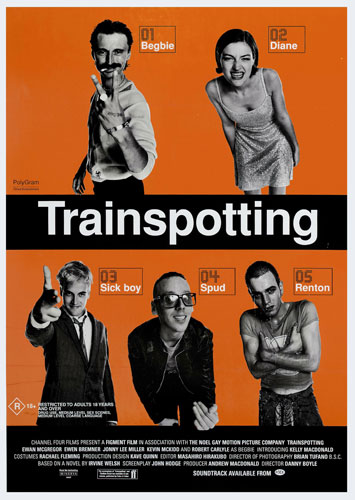
This poster of ‘Trainspotting’ has a bright and colourful orange background, with everything else on the foreground black or grey tone except from the white title which stands out against the rest of the content. They use the characters to intrigue the audience to watch the film, it instantly shows you its set in the 80s ‘sex, drugs and rock &roll’ era simply through the characters.

One way in which my film poster challenges these forms and conventions is due to the fact that the actors within my film aren’t well known; they could not be the main attraction and so are not at the forefront of the poster. However, I had decided to put a picture of James Kennedy, the lead actor, a close up of him looking morose as he looks down. He is in his uniform and so I believe that introduces the concept of 'A long way from home'. I chose to manipulate the image and added a solarized effect (a bit like night vision- which would possibly have been used in the army) but changed the colour to black and white. The background colour is grey which then means the image stands out from the poster. I kept the text simple, only putting the title of the film, my name as its creator and 'coming soon'. I did not create a tag line as commonly used on posters as I did not feel it needed it, as they often create a sense of fear or danger in specific genre films. It also seemed to me that those that would fit my film would come across perhaps as "cheesy" or cliché.

Film reviews must include the main plot and a verdict for the film along with a rating; they must be eye catching with pictures so that the reader chooses to read the article in the magazine. The magazine layout itself must coincide with a house theme; its colour scheme musn’t be too bright and yet be colourful enough to attract attention. I chose to use colours which reflected the theme of war and the army; there is the picture of James Kennedy in a army uniform in the foreground and the background starts with a light cream colour from the left hand side getting darker across the page. These colours reminded me of a desert, like when they were fighting in Aghanistan.

How effective is the combination of your main products and ancillary texts?

The combination of my short film with its poster and magazine review is very effective as the ancillary texts are used as promotional purposes for ‘A long way from home’.


Film posters, were merely meant to promote and entice viewers to come to the local theatres that were screening the films. Ironically in the early days of movie making actors were not usually depicted on the film posters. The title of the film and the producer and directors names were usually the attraction until Hollywood realised that it was the actors who brought in the viewers. It was at that time that the stars of movies were then plastered on each poster giving life to a new era in the film industry. It usually contains an image with text, though this has evolved over time from image-free posters through to the highly visual digital productions of today. The text usually contains the film title in large lettering and often the names of the main actors. It may also include a tag line, the name of the director, names of characters, the release date, etc. Film posters are displayed inside and on the outside of movie theaters, and elsewhere on the street or in shops. The same images would appear in a film exhibitor's pressbook and may also be used on websites, DVD-packaging, flyers, advertisements in newspapers and magazines.

Film reviews in magazines reach a huge demographic, depending on the status of the magazine and the type of films they tend to advertise. If that magazine’s audience depend entirely on their review of a certain film before seeing it and the review of a film is bad, for instance the plot is not interesting or the actors do not perform to a certain standard then this will mean a big percentage of the film’s intended audience will refrain from seeing the film.

What have you learned from your audience feedback ?

Audience feedback is crucial as it allows me to gain an insight on my target audience and their views of the film, for instance what works well or not.
I had audience feedback for various things, including finding a title for the film. I created a list of numerous film title ideas and then asked which one they prefered, the one with the highest votes is the one I chose for my Short. This helped me get an outside percpective, once I pitched my idea for my film and what title suited it.
I also constructed a questionnaire for my audience to fill out after having watched the film, this then allowed me to gain insight on their thoughts of the film, and where I went wrong or what bits were particularly successful.
Having collected the data from these questionnaires, I found that there is a limited amount of people who actually watch Shorts. However from those who did watch it, they found that the genre was successful as it "gave thoughts of the people involved on the subject". Feedback showed that they thought it seemed realistic, particularly the scene in the pub with Lewis' character.

These are some of the comments from 17 year olds, the first is male and second female:
"The story was believable and had a good back story. The flashbacks were well used."
"The film was very powerful, and the flashback made the film realistic. The use of camera in the way it was like a documentary was successful. Moving."

Some comments for improvement were for the camera shots to be more steady, however I believe that works well for the documentary as it is one its' conventions.

As well as the questionnaires, I uploaded my coursework onto Youtube so that people can leave their comments on there and it would become available to wider audience.

http://www.youtube.com/watch?v=FiK3ncWMsEg


How did you use media technologies in the construction and research, planning and evaluation stages?

I created a blog at the beginning of the planning process, which then allowed me to post each step of my research and planning. I was also able to post links of websites that helped me with theories or conventions and also those with videos of examples I looked at. A blog has unlimited space and so allowed me to post as many posts as I needed to as well as uploading pictures, videos and links. I was then able to control and edit all my posts through the main ‘blogger’ control pannel and dashboard.

I used the internet as a major part of my research, whereby I looked up the different conventions of genres I was looking into, and I explored various films that related to my specification. Google search engine was very useful in this part of my planning and research; it offered me many relevant sites coinciding with my search. Amongst the internet I used ‘Youtube’ and music websites such as ‘we7’ to find songs for my film; I was able to use the websites’ search engine to look for a particular genre of music or songs by a specific artist. It also allowed me to simultaneously play the songs on that website as well as my film in the editing process of iMovie09, in order for me to see if the song suited the scene.

I used a video camera in order to film all my scenes needed for the film, this was then connected to a Mac computer by a FireWire so that I could upload the footage onto iMovie 09, which I used to enable me to construct my film.


This enabled me to compose the different scenes together, all the while editing them in terms of colour, sound or text. iMovie is a non-linear editing process, which, with need to compress and decompress video leads to some loss in quality; however I felt that it was very efficient in allowing me to compile all my different shots alongside the music, text and also my added stills.

For my ancilary tasks (the poster and magazine review), I used a DSL camera to take the pictures I needed and then used Adobe Photoshop to edit them and create both my poster and magazine layout. This program enabled me to create more effects in terms of making them look attractive to the intended audience, I was able to manipulate the picture in order to make it seem more realistic. It also gave me a wider range of colours and fonts to use than if I would have used Microsoft Office Publisher, as Photoshopt has a professional standard and creates broadcast quality.

Thursday, 22 October 2009

Film Poster Ideas

This is just an idea for the poster of the film. I want it to be simple, but I do think that the final piece will be in colour. The concept of the poster will be a soldier walking towards his home. I wanted the shot to be from far away with the sun shining behind casting a shadow on both the soldier and the house, I also want the house to be isolated in the shot and only have one long path between the two. As for the text (title and actors) I will not stay with this exact font [though similar] and I will also include the production company and distributor along with the actors' names. I do not feel that their names need to be very big as they are not well known and I would prefer for the picture to be the main attraction of the poster. There will also need information on the release date of the film and other related details.

Thursday, 24 September 2009

Images for his Nightmare in the first scene


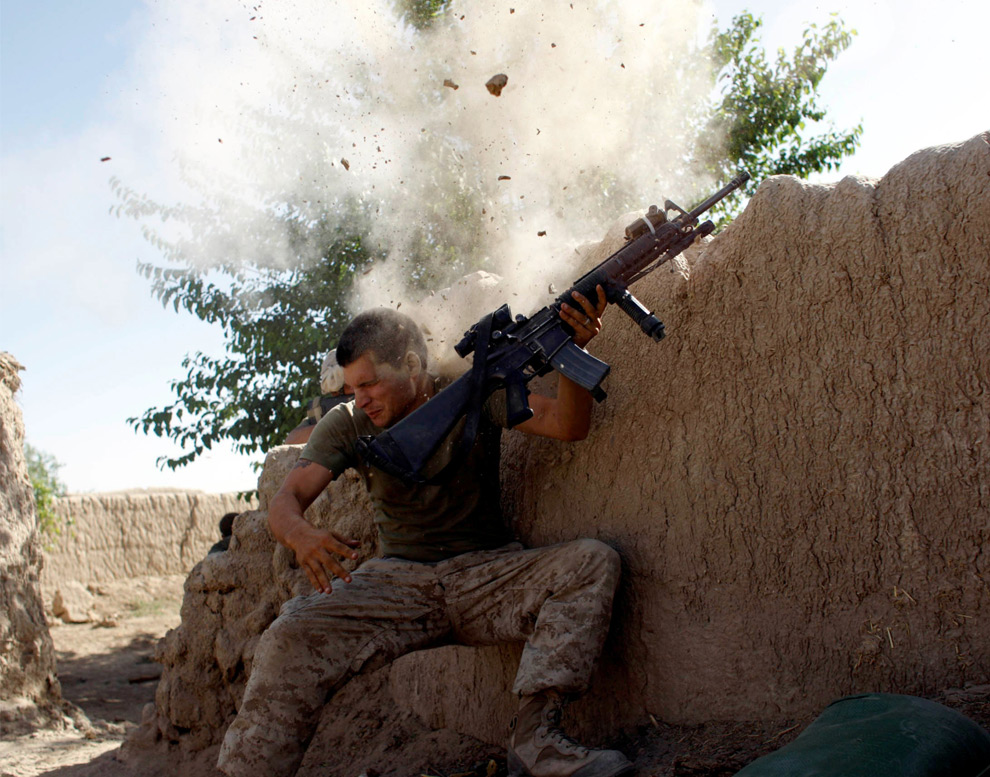
I want these images to show what he lived through and what he has to re-live all the time, the events that caused his PTSD to start.


Wednesday, 23 September 2009

Post Traumatic Stress Disorder (PTSD)

How does PTSD start?
PTSD can start after any traumatic event. A traumatic event is one where we can see that we are in danger, our life is threatened, or where we see other people dying or being injured. Some typical traumatic events would be:

serious road accidents
military combat
violent personal assault (sexual assault, rape, physical attack, abuse, robbery, mugging)
being taken hostage
terrorist attack
being a prisoner-of-war
natural or man-made disasters
being diagnosed with a life-threatening illness.

When does PTSD start?
The symptoms of PTSD can start after a delay of weeks, or even months. They usually appear within 6 months of a traumatic event.

What does PTSD feel like?
Many people feel grief-stricken, depressed, anxious, guilty and angry after a traumatic experience. As well as these understandable emotional reactions, there are three main types of symptoms produced by such an experience:

1. Flashbacks & Nightmares
You find yourself re-living the event, again and again. This can happen both as a "flashback" in the day, and as nightmares when you are asleep. These can be so realistic that it feels as though you are living through the experience all over again. You see it in your mind, but may also feel the emotions and physical sensations of what happened - fear, sweating, smells, sounds, pain.

Ordinary things can trigger off flashbacks. For instance, if you had a car crash in the rain, a rainy day might start a flashback.

2. Avoidance & Numbing
It can be just too upsetting to re-live your experience over and over again. So you distract yourself. You keep your mind busy by losing yourself in a hobby, working very hard, or spending your time absorbed in crossword or jigsaw puzzles. You avoid places and people that remind you of the trauma, and try not to talk about it.

You may deal with the pain of your feelings by trying to feel nothing at all - by becoming emotionally numb. You communicate less with other people, who then find it hard to live or work with you.

3. Being "On Guard"
You find that you stay alert all the time, as if you are looking out for danger. You can't relax. This is called "hypervigilance". You feel anxious and find it hard to sleep. Other people will notice that you are jumpy and irritable.

Other Symptoms
Emotional reactions to stress are often accompanied by:

muscle aches and pains
diarrhoea
irregular heartbeats
headaches
feelings of panic and fear
depression
drinking too much alcohol

using drugs (including painkillers).

What can interfere with getting better?
You may find that other people will:

not let you talk about it
avoid you
be angry with you
think of you as weak
blame you

These are all ways in which other people protect themselves from thinking about gruesome or horrifying events. It won't help you because it doesn't give you the chance to talk over what has happened to you.

You may not be able to talk easily about it. A traumatic event can put you into a trance-like state which makes the situation seem unreal or bewildering. It is harder to deal with if you can't remember what happened, can't put it into words, or can't make sense of it.

Monday, 21 September 2009

Magazine layout for review


I prefer the 'Watchmen' review as it is more bold and colourful, attracting the audience to read it. It also uses more pictures, and at the bottom inlcudes a piece in the style of the comic books that the content of the film originates from. The 'Twilight' review seems to have more depth as the there is more text, though readers may not want to read this full review as it appears quite long. However, Twilight has a huge fan base and as many people would be anitcipating this film, the review must include all the information that they relish.
I don't think my review could be that long, as it is only a short film, and they differ from feature length film in their audience and content. My review will include atleast one picture and be short in lenght but with language that will make the audience intrigued to watch the film.

How does my short film link to the review and poster?

Both posters and reviews help promote the film and try to persuade its audience to go see it in cinemas. The posters enable audiences to get a feel for the film, its a chance to 'big up' the film, this can be done using the star actors (their names or pictures) or by portraying the film through a picture that would captivate them and persuade them to go see it. The review gives the audience an opinion of the film, which if they are a frequent reader of the particular magazine, they will go by. It should include good and bad points about the film, a rating, but it should not completly give the film away for there to still be a element of curiosity.

Image / font / typography etc. research


Films always have their own font/ typography, an image that sets them for that film, especially if there is a sequal to the film, for instance the 'James Bond' films and the 007 logo.


As my coursework is not a war film, but a film about a war soldier and his family, I think finding the right typography is harder. I want my font to be bold but quite plain and simple to keep with the theme of the film.
I chose to use 'Orator Std' on Photoshop for the title, as I though this was simple and yet still effective with the straight lettering conveying the serioussness of the topic and the boldness to make it stand out.

Thursday, 17 September 2009

Storyboard and Script

Storyboards:
[ Click on images to enlarge ]


This is my first storyboard for the first of my short film. I was unsure of the title and so called it 'A strange return', though I prefer 'A long way from home'.


The film starts with a clip from the news talking about the war in afghanistan, however I was unable to get it straight from the BBC and so I changed to shot to an over the shoulder shot of Helen watching the news on Youtube. The three images are those I chose for the 'dream sequence'.
I didn't put in the title shot with the loud gasp as I was unsure where to put it, but when editing, I chose to put it after the 'dream sequence' as I thought that is where it would be most effective.

I decided what music to use after having filmed the scenes, as I could then use iMovie to see what went well with what I had created.

I added the 'memory reel' before he shoots himself, to show the times when he was happy. I chose to do this when editing as I had footage which I had to not used and thought it would work well. I also added stills when Ryan is talking to emphasise his point.

I decided to end the film with Helen crying for Ryan and then slowing fading out to the end credits; the fade representing death.


Ryan and Helen's scene in bed:

Ryan is shaking in bed after having had flashbacks.
Helen: Shh placing her hand on his chest
Go back to sleep honey, It was just a dream

This scene will be in early morning, so I want soft ambient lighting coming from the window in the bedroom to create that morning mist.

On the stairs:

Ryan is sitting on the top of the stairs, Helen walks over the join him
Helen: Placing her hand on his shoulder
I know it's hard Ryan, but you will get through this
Ryan: How do you know that? You don't know what I've been through...
Stop trying to fix me!
Helen storms off down the stairs

The lightin for this scene will be soft and ambient, coming from the window overlooking the top of the stairs. This will then create a fill light to the side of Ryan, creating a soft shadow on the other half of his face.

Helen's interview:

Helen is at the kitchen table, with a cup of tea
Helen: We've been together since high school.
He proposed to me in Rome, it was so romantic
and ofcourse I said yes!
He was so sweet at first, everything was perfect
but then after year of being married, he told me
he was going to joing the army...
Starting to become upset
It was hell without him, but when he finally
came home, everything changed...

The lighting for this scene will be ambient , incident light from the sun flooding in through the window.

Jack's interview:
Jack is drinking beer, having just stepped out the pub
Jack: He won't come out with the lads anymore.
He just stays in and sits on his arse all day
watching TV, I don't even know if he switches the TV
on! I know he's been through a lot, we've all scene
it on the news, and god knows it was worse actually
being there, but isolating himself is not going to help
him. I feel sorry for Helen, must be worse than when
he was away and I bet there's no sex in that marriage.
I..I just, I just feel sorry for both of them!

This scene will take place outside in the night time, the lighting will be incident light from the artificial lighting outside the pub and from the light posts on the street nearby.

Ryan's monologue :

'This is fucking shit. I can't close my eyes without reliving every little aspect of my time out there. I'm all alone...
They can't understand what I'm going through. Therapy won't work, I'm too deep into this now.
I want my life back...I want Helen! Oh Helen...
I can't even fuck my wife!
She's not happy and nor am I. '

For this scene, Ryan will be alone in a dark room only using ambient lighting to create a morose atmosphere, perhaps later editing the colour temperature. This will be a fill light, as the light will come from windows on only one side of the room.

Monday, 14 September 2009

Example of a Short film - documentary

http://www.bbc.co.uk/dna/filmnetwork/A39561023


Tashtastic

Tessa Morgan
average rating from 7 members

documentary 2007 London 3 min

Published 06 Mar 09

An insight into the mind of a debut competitor at the 2007 Biannual World Beard and Moustache Championships.

I think because the competition is so unsual, it makes the documentary more intriging.

I would not have my film to be a complete documentary as, unless it is a very interesting subject matter, I don't think it could entertain an audience for the full length of time, I think adding the drama genre, makes it more interesting.

FilmGuru Short Film Review

John T. Woods stars as a man despertately trying to win back the affection of his ex-girlfriend in 'I F*cking Hate You'. (Sabi Pictures, 2008) Directed by: Zak ForsmanWritten by: Zak ForsmanStarring: Marion Kerr and John T. WoodsRated Running time: 9 min. FilmGuru's Rating : 9 out of 10.

When I started to watch the short film by director Zak Forsman, I imagined all types of sophomoric angst that could be behind a film called I F*cking Hate You. The title seemed pulled from the notebook of a first year student who thinks "offensive" is synonymous with "edgy." Nevertheless, I grit my teeth and watched it; waiting for the spew of expletives that I was sure would follow.


Instead, I found a soft, nervous drama. A man (John T. Woods) is trying in the most clumsy way to reunite with his ex-girlfriend (Marion Kerr). The moment seems lifted from real life. He brings her a box of their things, offering her the chance to rummage through these mementos before he turns them over to charity. However, the one item she wants – a coffee mug – isn't in the collection. If she wants it, she needs to come by his apartment.
The short film took less time to watch than it will take me to write this review, but it was polished. The improvised script came across as genuine, even if it stumbled at times. The camerawork made the most of light and shadows in the half-lit apartment. And the acting was often inspired. There is a moment when Kerr's eyes shift ever-so-slightly, and it's as if she's telegraphing every thought in her head.

The film is Dogme95 certified, meaning that it follows the rules of the group's manifesto. Essentially, this means that the filmmaker works on location and avoids the trappings of post-production, striving for purity in film. According to the film's official website, IFHY broke a few of the rules but "proudly reflects the spirit of Dogme95 and its raw, minimalist esthetic."
Forsman does a lot with very little. He gets some great performances out of the actors and builds a short film that is worth a few minutes of your time. The entire thing is a joy to watch. I loved it, which says a lot considering the title.
I like the fact that this review was written in a more personal way, though depending on how reliable the author is, it could hinder the film, if audiences usually don't agree with his point of view. I don't think that I would write my review in the same style, though it does show a review of a short film.

Empire Online Magazine review + Poster


500 Days of Summer (12A)


Plot

Tom (Gordon Levitt) falls in love with Summer (Deschanel) but things don't go quite according to the romantic dream he has in mind.


Review

(500) Days Of Summer is the cinematic equivalent of a song. If you want to get specific, it’s the cinematic equivalent of a Belle And Sebastian song: self-consciously quirky, certainly, but wry, winning and full of irresistible hooks.


What (500) Days feels like is a compilation of conversations and bits that would fall through the gaps in a traditional rom-com. Eschewing meet-cutes (this couple meet boringly at work) and last-gasp dashes to the airport, it is a film about the thrill of realising the girl you fancy loves the same band (in this case, The Smiths), the joy of making trips to Ikea magical adventures or the hollowness of going out on dates when you’re still pining for your ex. Yet, like a warm ’n’ fuzzy Memento, it scoots through these moments in a fizzy, random discontinuity, butting the good times against the painful memories, gaining emotional mileage as each informs the other.


Scott Neustadter and Michael H. Weber’s sparky, ingeniously structured screenplay is given maximum pizzazz by pop promo director Webb, throwing in a joyous dance number to celebrate Tom’s (Joseph Gordon-Levitt) first night with Summer (Zooey Deschanel) or a clever splitscreen to show the expectation vs. the reality when Tom tries to woo Summer back. Not all of it works — an omniscient narrator is introduced then forgotten about, Tom has a wise-acre kid sister (Chloë Moretz) doing the Wisdom Beyond Her Years thing — but there is so much beguiling playfulness that, if something falls flat, there is always a great Han Solo gag or Fellini parody just around the corner.


Standing up for the foolishly romantic, the charming Gordon-Levitt registers every ounce of hope, joy and angst beneath his geeky demeanour. In the guardedly romantic camp, Deschanel has done the enigmatic space cadet before — see Yes Man and Gigantic — but gives it a melancholy twist. It is, perhaps, ultimately too smart-aleck to have real emotional wallop. You wish that the film would give Summer the same TLC it lavishes on Tom, and the film has a last-gasp gag that feels pat at the end of something that previously felt something like love itself: gloriously unpredictable, effortlessly fresh and, at its best, leaves you high as a kite.


Verdict

Perfectly played, simultaneously serious and light, endlessly inventive, this is a strong contender for the most original date movie of the year. (Terrific) stuff.
I think this review was well written as it picks out moments in the film that stand out and intrigue the audience. The use of language such as "fizzy" and "sparky" makes the film appear very light and funny, which people can pick out and then decide if that is the sort of film they enjoy. It includes films that Deschanel has already been in, so that people who liked those films may be more inclined to watch this one too. I think I will use these successfull elements in my review, though the genre is not the same, I will try to convey the mood of the film through the language.
This is the movie poster for the film. It shows the two main actor's names at the top of the poster on either side, perhaps reflecting their equal parts in the story. There is then presumably 500 pictures of 'Summer' the character with a blue tint, making up the sky with a sun right behind the title and Tom's character at the bottom sitting on colourless grass. There is a tagline: 'This is not a love story, This is a story about love'.


I think this poster works well, as it embodies the title of the film; using the pictures of summer to create a summer sky and sun. I would like to try to this for my poster, though perhaps a bit more subtle.

Thursday, 10 September 2009

Logistics

Actors - James Kennedy, Rebecca Askwith, Lewis Page, Luisa Di Maria

Props - Gun

Location - Hitchin - bedroom - a double dedroom in my house as it is a neutral colour and I like the lighting that comes in from the window onto the bed.
Living room? Kitchen?

Character Profile :

Actor Name : James Kennedy

Character Name: Ryan Rutherford

D.O.B: 12.07.84

Occupation : Soldier


Ryan is a soldier married to Helen, living in the little town of Newberry'. He was a very lively man; he enjoyed socialising and played various different sports. He was working as a sport coach , when he decided to go to the army. After 4 years of the army, Ryan Rutherford returns to his awaiting wife as a changed man and not for the better.

I chose James to play the role of Ryan as he appears to have the build of a soldier and also looks older then he is, aswell as being a good actor.

Actor name: Rebeccas Askwith Luisa Di Maria (Rebecca was enable to do it)
Character name: Helen Rutherford
D.O.B: 26.04.(85/86)

Occupation: Social Worker

She is a 'small town' girl, and doesn't need much. She enjoys working with children, and has a delicate personality, though she also enjoys having a laugh and going out socialising. Helen and Ryan have known each other for years and have always dated on and off, untill they finally married. They were happy when to Helen's despair, a year later Ryan was off putting his life on the line.

Actor name: Lewis Page

Character Name: Jack Page
D.O.B: 08.03.86

Occupation: Mechanics


Jack is a very close friend of Ryan's; they were in school together and have always lived near each other. Throughout Ryan's absence, he feels obliged to look after Helen.


Target Audience

No film is for everyone. Each film has a target audience. A target audience is defined primarily by gender and age range. Additional elements include socioeconomic status, rural or urban, race, family status, theatre goers or not, and special interests. These interests can include anything from political leanings to religion or the particular subject matter of the film, such as running (Saint Ralph), visual art (Pollock) and human rights (Hotel Rwanda).Typically, age ranges break down as follows:

-Kids 5-11 and mums
-Tween 11-14
-Teen 13-16
-17-21
-18-24 and 18-34
-25-54
-54+

The 18-24 and 18-34 range makes up the largest movie-going segment, the core of big audiences and stiff competition.

There are potential marketable elements or hooks that can attract a specific audience, though not all hooks apply to every film.

Genre Each genre such as comedy, action, thriller and romantic comedy attracts different audiences and those audiences can be further fragmented. The genre of my piece is a docudrama; a fictional documentary with aspects of drama.
Concept In comming up with the concept of my short, I thought of real life events and thought of Afghansitan and the situation there, then remembered videos I watched in Pyschology of past soldiers not being able to sleep and never being able to live down their experience. I thought of 'Shawshank Redemption' for the idea of Ryan killing himself, when the character in the film is released from prison and hangs himself.
Tone The tone of the film is quite sad, showing the 'reality' of coming back to a 'normal' life after having spent years in a state of war.

Attractiveness of the protagonist to the audience I don't know if the audience will highly indentify with the protagonist, perhaps on a similar level, whereby they have lived through something which they now cannot live down. I think the audience will be able to get emotionally attached, and feel sorry for the soldier and ofcourse his wife.
Subject matter The film being a docudrama will bring home the subject matter in a different way, than a feature length film.

Other marketable elements could be Additional elements, this includes hooks such as the music used, Special interests or Source material.

Short films are different from normal comercial feature films, and may be more popular amongst young film makers, as shorts are cheaper and easier to make, usually don't take very long to produce, and their brevity makes shorts more likely to be watched by financial backers and others who want some demonstration of a filmmaker's ability (or, conversely, the format allows for more experimentation since most of them are unlikely to be seen by a wide audience). If my short was to be uploaded onto the internet on a site like YouTube, this may attract a larger audience it can then be advertised on serveral internet site with links to the film on YouTube. This would also then show the amount of 'hits' it has, and if this number reachers a vast amount, it could then attract people of the industry to take interest.

I think my target audience is the core audience of the ages 18 to 34, as this is only a short film, which may attract more people and it involves a current issue that some people are passionate about, or may know of someone in the army also.

Film Title Ideas

'A strange return' I
'Long way from home' IIIII III
'Urban Warfare' III

Audience feedback:
I asked my fellow students in one of my classes to chose between the 3 choices, and 'Long way from home' has the highest vote.


Chosen Title:
'Long way from home', I think this is a good title, as it has the literal meaning whereby the soldier has been away from home, but when he returns he is mentally away from home as he is suffereing from post-traumatic stress disorder.

Wednesday, 9 September 2009

My Short film

After having looked at differnt examples, I decided to make my film both a documentary and a drama, so to be able to convey my narrative through both interviews and shots of their lives.
I wanted a serious issue as I thought the documentary would help in making the narrative seem more realistic. I wanted to look at what is happening in Afghanistan and how that is directly affecting families and the soldiers themselves.

For my Advanced Media Portfolio, I have decided to create a short film of a soldier's return home after years of being away. My film is going to be a docudrama; a drama with aspects of a documentary, such as interviews with the soldier's wife.

First Scene:
The film starts with clips from the news of the war in Afghanistan, which then cuts to different pictures of the war (victims and soldiers) in quick succession. There is then a black out where you then hear a loud gasp. Keeping with the black backdrop, it cuts to the title page. This then fades to a shot of the soldier and his wife in bed, his eyes are wide open, she turns to him to tell him to go back to bed, the camera then pans further to his side of the bed to show him lying on the bed with his gun to the side of him.
Second Scene:
The shot then cuts to an interview with the wife in the kitchen, she is sitting down at table with a cup of tea talking about her husband's return. As she speaks about how he use to be, there are flashbacks of him before the war. The shot shows him laughin and playing around with his wife. (watching a film or something easy to film?)
Third Scene:
There is a shot of the soldier looking lifeless in the living room infront of the television, the shot then arcs to the room where there is a shot of his brother (or some kind of relative) in another interview, talking about how they miss him(...ect)
Fourth Scene:
Monologue from the soldier..."I'm just not happy in the fucking place, these images they haunt me...." (as he speaks either voice over as shots show him and how unhappy he is OR shows him talking into the camera, perhaps at night - like a sort of diary?)
Fith Scene (Final Scene):
Wife wakes up in the morning to find that soldier has killed himself, see her crying. She walks away, not wanting to talk to the camera. Camera drops and cuts to white noise. There is then a picture of the soldier as a final shot.
This is just the first draft of my film, there are some aspects I'm not too sure about which I will have to try out different options.

Examples of Docufiction film


The 2002 – City of God (film) by Fernando Meirelles, Brazil is a good example of a docufiction film. It is based on a true story, adapted by Bráulio Mantovani from the 1997 novel of the same name written by Paulo Lins.


This film documents the life of different characters in the 'city of God', narrated by 'Rocket'. It shows the war between two gangs, and gives us an insight from both sides. I thought this film was well done, and even though it was in "subtitles", it was easy to follow.

Examples of Film Posters

I like this poster for 'The thin red line'. It shows a list of "a-list" actors on the left hand side, such as 'George Clooney' and 'John Travolta', this will instantly attract audiences, as these are highly regarded actors who have a history of good films under their belt. I also like the layout of the soldiers, and the fact you can only see their eyes under their helmet. The tagline 'Every man fights his own war' suggests that this film is much more than just another war film, and that the characters are much more complex. The 'Punisher' poster is much simpler in its' layout and design. 'Vengance has a name' at the top and the skull on the character's chest, reflects an evil theme within this film, along with the black background and the light comming from the top, showing only the top of his head, leaving the rest of him in the shadow; suggesting that this isn't a normal war film, and is perhaps one man, or a group against "the world".


I like this Quentin Tarantino poster for 'Inglorious Basterds', as it isn't too busy; it's simple and effective. The title of the film is engraved into the gun being held by a character the audience cannot see, and therefore it makes them curious as to who it is, rather than showing the stars of the film and relying on that. In a sense, it gives a message that this film is more than the actos (although there other posters with Brad Pitt and his co-stars). It also has a tagline: 'Once upon a time in a Nazi occupied France', this introduces the context of the film. Quentin Tarantino's name is the only one on the poster as he is a famous film director with well known films, such as 'Pulp Fiction' and 'Resevoir Dogs'; this will intice fans of his work to see this film.
'Brothers at War' seems like the 'friendlier' film out of the four, it shows 3 men at the bottom and a merged picture above of 3 boys on swings which hints that this was the 3 men when they were younger. Also merged in the backdrop is the american flag, which suggests that this is a 'american pride' film, of men fighting for their country. The list of actors and name of director are in small print on the right hand side, which shows that they aren't the main attraction of this american film.


Monday, 13 July 2009

Conventions of shorts and docufiction

Short films have their own specific features, including:
-A likelihood of ambiguity or the unexpected in the narrative;
- small number of characters;
-heightened use of mise-en-scène and music;
-Minimal dialogue and powerful themes.

Docufiction is a neologism which refers to the cinematographic combination of fiction and documentary. The term involves a way of making films already practised by such authors as Robert Flaherty, one of the fathers of documentary, and Jean Rouch, in the 20th century.
It also implicates the concept that fiction and documentary are basic genres, due to the ontological status of the filmed image as photography: the double is shown as being the same, as representation and reality. Being both, docufiction is a hybrid genre, arising ethical problems concerning truth.

Conventions of Documentaries
-Archival Footage and Photographs : Archival materials include old photographs, newsreel footage, and even shots from fiction films
-Talking Heads: These people usually are shown in their offices or in their homes
-Jiggly Camera
-Voiceover Narration
-Re-enactments
-Real People

Conventions of Drama/Fiction
Dramas are serious, plot-driven presentations, portraying realistic characters, settings, life situations, and stories involving intense character development and interaction. Usually, they are not focused on special-effects, comedy, or action, Dramatic films are probably the largest film genre, with many subsets.

Wednesday, 8 July 2009

Pin Point

http://www.pbs.org/independentlens/insideindies/shortsfest/dl/pinpoint.m4v

Film by James Kim

This short is different from others i have looked at; it is much shorter and is also an animation (rotoscoped). It's about a evil orphanage caretaker who tries to poison the children, and then one of the girls there makes a voodoo doll and takes revenge. It may be a animation, but it seems a bit violent, especially at the end where in the last scene the little girl goes with scissors to cut off the head of the voodoo doll, and so not much is left to the imagination.
I do however like the idea of an animation, though I believe for my project that it would be best not to do an animation as I don't think i would have the skill, time nor right software to create something to a realistic standard as I would want to.

Storyline Ideas


Contemporary Issues

I want to make my film relvant to contemporary issues, these show possibilities:

- Sex and relationships
- Knife/Gun crime and violence
- Poverty and homelessness
- Media Obsessed/ Social networking
- Love
- Child abuse
- Drugs
- Politics

Bullet Proof Vest

http://www.pbs.org/independentlens/insideindies/shortsfest/dl/bulletproof.m4v

Dir: May Lin Au Yong

Nine-year-old Jyeshria wants a bulletproof vest—and she's dead serious. In a city riddled with gun violence, fed up residents take action.

I like this above short, I think it is very powerful in making people aware of the violence in Richmond, California and how people live. The whole clip is in black and white and has voice over, and shows the area and the children, and their protest to stop the violence. I think it is very effective in its documentary form as it shows that it isn't fiction and that it is a serious issue worth considering.

The Camera angles portrays the neighbourhood through the people's perception; different cuts of the area as they are speaking about it, over the shots and it embodies how they feel about what is going on. Showing that it has potential, if the violence could stop, for instance the shot of the play area - it seems hostile and so perhaps they do not like playing there as it is dangerous, but does not look so different as others. Those speaking rarely look directly at the camera when they speak, which is a feature of documentaries. I think the black and white emphasises how they are feeling, there is no "colour" in their lives and I think this is an effective way of highlighting the point of the film.

The use of the documentary form is effective and goes well with the narrative; this would work well for my Short as it can be done in 5 minutes. If i were to chose the documentary genre I would also chose a contemporary issue that I wish to raise as the genre would enable me to raise awareness and highlight the elements I would need to through direct speech as well as shots to emphasise what they are saying.

Monday, 29 June 2009

Kiwi!

Directed by : Dony Permedi (2006)

The video begins with the title character dragging a rope that is obviously attached to something heavy. He ties the rope to a tree, and we see that the trailing end leads over a cliff. He runs to the edge of the cliff and slides down the rope to a brown platform below. The platform is perpendicular to the cliff and supported using only the aforementioned rope. Using a hammer and nails, he proceeds to nail the end of the platform to the cliff face, holding the hammer in his foot. The view zooms out to show us the platform is a tree, now nailed to the cliff by its roots. The kiwi climbs back over the cliff edge and looks over, to see many trees similarly attached to the cliff. He claps his feet together in a form of applause at the completion of his task, and proceeds to remove the rope. He runs out of frame, and returns wearing an aviators hat and goggles. He takes one final look over the edge, before moving back, and then taking a running dive over the cliff edge. We see him diving straight downwards, falling past numerous trees nailed to the cliff. The frame slowly rotates 90 degrees to the left, and suddenly the scene seems to show the kiwi soaring above a flat landscape and trees. The shot zooms in close to the kiwi, and we see him extend his small and flightless wings and proceed to flap them rapidly as though flying. He closes his eyes and a single tear escapes. The camera slows and watches as the kiwi soars on into the mist. As the scene fades to black, we hear a heartbreaking thud.

I like the end of the film and how it draws emotion from the audience as they see that single tear, it shows joy that for instance he is flying but also shows that he also knows what is going to happen. The scene fades before we see anything, we only hear the thud. I think this is effective, rather than showing what could have been a horrific scene. I think if i were to include a death or something similar in my Short, I would not show it in the film and perhaps only use the sound as 'Kiwi!' has done.

Plan of possible genre of the film

I looked at the possible genres that I could use for my Short film and possible narratives based around them. Some would simply not work in the 5 minutes I am entitled to create my piece, these are simply crossed out in the list below.


Action
Adveture
Animation --> This could make it into a short cartoon clip, or perhaps a cutout collage like South Park animation, or it could be a stop-and-go animation though this may take a while.
Biography
Comedy --> This genre can be quite hard to do, as it may try to hard to be funny, but can be merged in without other genres.
Crime --> This would be a quick 'solve the murder' film, perhaps begining with the scene of the crimer taking place, keeping the person who did it a mystery.
Documentary --> This would be the easiest option for the short amount of time I have for this short. It could be a documentary about school, a workplace of perhaps someone interesting.
Drama --> This is a broad genre, which would allow me to incorporate other genres and I would then have more to play with. This could be a romantic drama or family drama, revolving around the main protagonist; perhaps a teenager as we are looking at the representation of youth.
Family --> This coicides with the 'drama' genre, whereby there could be family problems between the parents e.g. an abusive dad or the child could be a rebel which would be tearing the family apart.
Fantasy
Film-Noir --> This could incorporate the 'crime' genre, and could made quite 'old school' whereby it would be a black and white film, with actors in costumes from the time.
Game-Show --> This could perhaps be a shortened version of 'Slumdog Millionaire', whereby it would be based on a game show, where there could be flashbacks helping the contender to answer the questions or play whatever the game is.
History
Horror
Music --> This could show a teenager wanting to become something in the music industry, and maybe having their family not approve.
Musical
Mystery
News
Reality-TV
Romance --> A short love story, showing a first encounter, first love or teenage love, perhaps highlighting aspects such as (first time)
Sci-Fi
Short
Sport
Talk-Show
Thriller
War --> This could show the homecoming of a soldier, maybe showing how hard it is to readjust to normal society and back to the normal responsibilities of life, and perhaps the soldier may have problems sleeping as he keeps thinking about the war and everything he went through.
Western


Due to the limited time of 5 minutes for the entire film, it is important to chose an appropriate genre for the film, for instance, I don't think the action genre would be good as I don't feel that is enough time to build on the climax and make it effective in 5 mins.

Monday, 15 June 2009

Boy and Bicycle (1965)

16mm, black and white, 25 mins

Director Ridley Scott
Production Company
BFI Experimental Film Fund
Producer
Ridley Scott
Written by
Ridley Scott
Theme Music
John Barry

The film follows the boy as he decides instead to play truant and visits various locations around the seaside town on his bicycle. All the while we listen to his thoughts in a stream of consciousness voice-over that Scott (director) has said was partly inspired by reading James Joyce's Ulysses (1922).
The voice-over reveals the frustrations of a growing teenager and mocks the authority figures in his life such as his teachers and parents. Scott storyboarded in detail before shooting, and he includes many visual elements that add texture to the film: a dead dog, the sun darkened by ominous storm clouds, and the eerie barrenness of the beach, which Scott has said was an homage to Ingmar Bergman's The Seventh Seal (Det sjunde inseglet, Sweden, 1956).

http://media.creative.bfi.org.uk/files/boyandbicycle1965-154241-cabfi0.mov
The above link shows a clip of the film.

Elements in this film that I particularly liked, and think that I could potentially use in my own film is the simplicity of the shots in the construction of narrative. I like the voice over, however I would not include through the majority of the film, I would perhaps have a narrator introduce the film like 'Mean Girls' for instance where Cady talks about her past and what has brought her over to this new school.

History of Shorts and Examples

Short subject is a technical description originally coined in the Indian Film Industry and even in the North American film industry in the early period of cinema. The description is now used almost interchangeably with short film. Either term is often abbreviated to short .
Although the North American definition generally refers to films between 20 and 40 minutes, the definition refers to much shorter films in Europe, Latin America and Australasia. In New Zealand, for instance, the description can be used to describe any film that has a duration longer than one minute and shorter than 15 minutes. The North American definition also tends to focus much more on character whereas the European and Australasian forms tend to depend much more on visual drama and plot twists. In this way, the North American form can be understood to be a derivation of the feature film form, usually acting as a platform for aspirant Hollywood directors. Elsewhere, short films tend to work as showcases for cinematographers and commercial directors.


Short subjects in the modern era
Since the 1980s, the term "short subject" has come to be used interchangeably with "short film," an international, academic term used to mean a contemporary non-commercial motion picture that is substantially shorter than the average commercial feature film. There is no clear definition of the maximum length of a short film, the Academy of Motion Picture Arts and Sciences classify it as 40 minutes, while IMDB refer to any film lasting less than 45 minutes as a short subject. The short-film form is to the full-length film what the short story is to a full-fledged novel.
Short films often focus on difficult topics which longer, more commercial films usually avoid. Filmmakers benefit from larger freedoms and can take higher risks, but they must rely on festival and art house exhibition to achieve public display. Most short films are better known outside the United States than within, due to less rigidity of audience expectation as to program content, arrangement and length outside the U.S. However, film shorts are often a popular extra feature on a film's DVD. For instance, Pixar's DVD releases of its feature films typically includes not only a short that was distributed with the feature film in its initial theatrical release but also an original creation featuring the characters from the feature itself. Likewise, Warner Brothers often includes selected animated shorts from its considerable archives on DVD releases of its family-oriented films that have a thematic relationship.


Internet
Such films can also be easily distributed via the
Internet; Across the Hall, for example, was solely distributed on the Internet. Certain websites which encourage the submission of user-created short films, such as YouTube, BritFilms and Newgrounds have attracted large communities of artists and viewers, whereas sites such as BBC Film Network focus on showcasing curated British shorts.

Television
Shorts are occasionally broadcast as
filler when a scheduled film's length cannot be conventionally fit in the standard broadcast schedule and the short is intended to fill in the remaining time of the timeslot. By contrast, Movieola is a Canadian cable channel devoted exclusively to shorts up to 40 minutes long.

Film Four Top Ten Short Films:

A Sense Of History
A tour de force performance from Jim Broadbent in this outstanding film by Mike Leigh. The 23rd Earl of Leete, a British aristocrat, tells his far-from-dull life story.

The Last Post
A young British soldier fighting in Buenos Aires in the early 80s finds himself separated from his unit. Stumbling across a young Argentinian fighter, the two young men reach a grudging understanding.

The Italian Machine
A trio of bikers liberate an Italian motorcycle from an art collector who wants it for display only. A trashy, camp, drug-fuelled delight from director David Cronenberg.

Call Register
Martin Freeman (The Hitchhiker's Guide To The Galaxy) and James Lance star in this witty tale of love lost and found, via mobile phones.

Mercy
Superb, subtly affecting film about a young boy who is neglected at home and bullied at school, finally exacting revenge on his tormentors.

My Parents
A young girl tries to impress her boyfriend by making her parents behave like they still madly in love with each other.

Le Fabuleux Destin De Perrine Martin
Perrine leaves the cinema after seeing Amélie - fascinated by the heroine's do-good deeds, Perrine decides to follow Amélie's example.

Talking With Angels
A beautiful, touching film about a young boy struggling to maintain a degree of normality for his family in the face of his mother's mental instability.

Simone's Labyrinth
An eerie, atmospheric film which explores the obscure inner world of the introverted and mysterious Simone.

The Sheep Thief
This atmospheric short by Asif Kapadia (The Warrior) charts the treatment of a young boy caught stealing a sheep.
